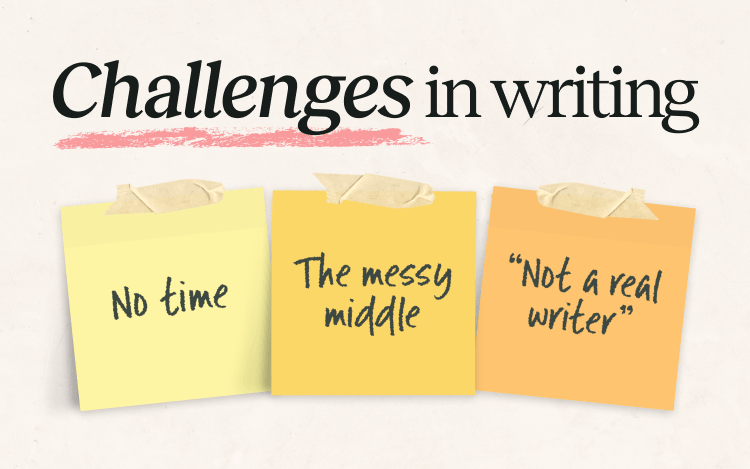
Every writer runs into the same handful of walls. Not enough time. Not enough momentum. Not enough belief that any of what they’re producing counts as “real” writing.
I know, because I’ve hit all three more than once. For years I thought each one was a personal failing rather than just what writing is like. It took working with hundreds of authors, and finally getting honest about my own tendencies, to see that these challenges are close to universal.
And more importantly, there are ways through them.
My name is Hayley, and I’m the Director of Community at ProWritingAid. Part of my job is talking to bestselling authors, ghostwriters, and writing coaches about exactly what actually stops people from writing and what gets them writing again. The other part of my job is being one of those people myself: drafting my own novels in whatever hours I can find around a full-time job.
The advice in this article isn’t a generic list of writing difficulties pulled from a search results page. These are the three challenges that have personally cost me the most time and the most finished projects, told the way I actually experienced them, along with what’s worked to help me move through each one.
Challenge 1: Never having enough time to write
My day job is writing and talking about writing. I run webinars for authors, build courses on craft, and interview bestselling novelists about their process for a living. And even with all of that immersion, I still spend most weeks fighting the same problem every working writer fights: there is a finite number of hours in a day, and my employer, reasonably, expects most of them.
For a long time, I told myself this was a temporary problem. That once things calmed down at work, or once I had a quieter season, I’d finally have “enough time” to write properly. That season never arrived. There was always a launch, a deadline, a busy quarter. Eventually I realized that waiting for more time was really just a polite way of not writing at all and that if I wanted to finish a novel, it was going to have to happen in the same fragmented, interrupted hours everyone else with a full-time job has to work with.
So last year, I set myself a genuinely ambitious goal: finish a full novel draft in 30 days, around that same full-time job, with no extra time magically appearing from anywhere. Some weeks that meant writing during my lunch break. Some weeks it meant a single 30-minute session squeezed in after everyone else in my house had gone to bed. I didn’t get more hours. I got better at using the ones I already had.
The first thing I had to let go of was the idea that a “real” writing session needed a real chunk of open time. Most of my sessions are 30 minutes, sandwiched between meetings or errands, and treating them as legitimate writing time (rather than a lesser, consolation-prize version of writing) made an enormous difference to how much I actually got done.
The other piece that helped me use those limited hours well was thinking about flow. Psychologist Mihaly Csikszentmihalyi spent decades studying the state of full absorption in a task and found it tends to show up under three conditions: a clear goal, immediate feedback, and a challenge that’s difficult but achievable.
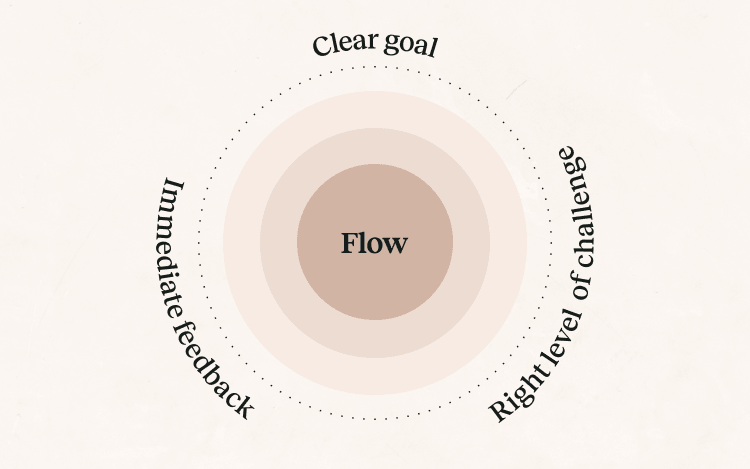
Before each session, I set a specific stopping point—not “write the chapter,” but “get to the moment she opens the letter”—and tracked completed sessions on a simple habit tracker so I had visible proof of progress, separate from how the writing itself felt that day.
If time is your biggest obstacle, the fix usually isn’t finding more of it. It’s changing how you measure progress against the time you actually have.
Challenge 2: Writer’s block (especially in the messy middle)
The middle of a project is where I’ve abandoned the most drafts. The opening is exciting because everything is possible. The ending is exciting because you can see the finish line. The middle is just a long stretch of “now what,” and that question has killed more of my manuscripts than any plot problem ever has.
The thing that’s helped me most with this isn’t inspiration. It’s having a backlog of small, specific ideas to reach for the moment I get stuck, so I’m never staring at a blank page trying to invent momentum from nothing.
Before I start any project I want to fast-draft, I build a scene list. I start with mind maps for the story and the main character, move into defining what my protagonist wants versus what they actually need, and then summarize the plot at increasing levels of detail using the snowflake method: three sentences, then three paragraphs, then (if I need it) three pages, one for each act. From there, I break the story down into a sequential list of individual scenes, usually somewhere between 40 and 80 of them.
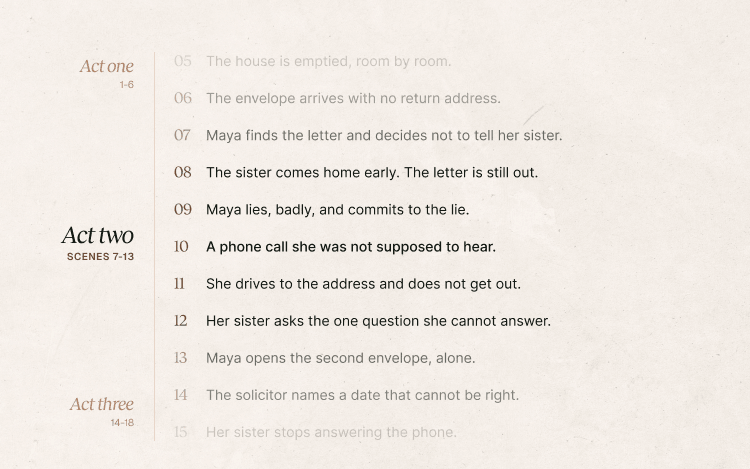
That scene list is what actually gets me through the messy middle. If a scene isn’t flowing, I don’t force it; I open a different one. Having 50 tiny, specific writing prompts tailored to my exact story means I’m never blocked for lack of somewhere to go next.
But even the best scene list runs dry sometimes, especially middraft when a character starts behaving in a way you didn’t plan for or a plot thread needs a new direction you haven’t thought through yet.
That’s the specific moment ProWritingAid's Creative Nudges mode is built for. Instead of a full structural analysis, you get a handful of quick plot and character-focused ideas to explore right where you’re stuck. Think a nudge to consider, not a diagnosis to work through. You can pick one that sparks something and keep moving without leaving the page you’re already on.
Writer’s block, in my experience, is rarely a sign that you have nothing left to say. It’s usually a sign that you’ve run out of the specific next idea, and the fix is having more small ideas on hand, not waiting around for a big one.
Challenge 3: Not feeling like a “real” writer
This is the challenge I’ve fought longest and the one no amount of craft improvement ever fixed, because it was never a craft problem.
I wanted to be a writer for as long as I can remember: scribbling detective stories in Lisa Frank notebooks as a kid, writing novel-length fan fiction on the school bus in middle school. But by high school, self-consciousness set in, and by the time I chose a college major, writing didn’t feel like a real option. That felt like a degree for people born with something I didn’t have.
I became a teacher instead, then somehow ended up writing professionally anyway: first lesson plans and leveled texts, then blog posts, then managing teams of writers, then eventually landing at ProWritingAid, where I now run webinars, teach writing courses, and interview bestselling authors for a living. I finished several novels of my own along the way.
None of that made the feeling go away. I still flinched every time I said the word “writer” out loud, like I was borrowing a title that belonged to someone else.
Then, last year, I posted a YouTube video that did better than almost anything I’d made before—until one comment stopped me cold. A stranger looked at how I appeared on camera and decided I wasn’t a real writer, based on nothing more than that. For a moment, it felt like they’d discovered something true about me that I’d been hiding for decades.
Then the nausea turned into something clearer: they didn’t know anything about my hundreds of bylines, my years of teaching, the fan fiction that had a thousand comments when I was younger. They’d decided who I was without any of that information. So I opened LinkedIn and added the word “Writer” to my headline, right at the top, before my job title. It wasn’t a grand gesture. But it was the first time I’d claimed the word on my own terms instead of waiting to feel like I’d earned it.
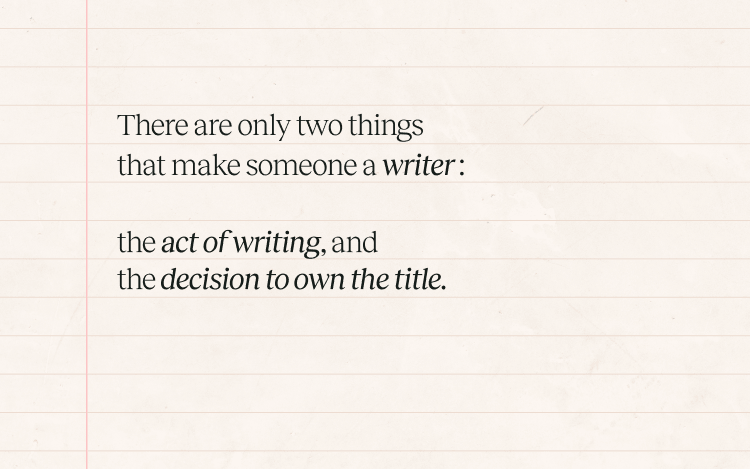
This feeling has a name (impostor syndrome), and it’s remarkably common, especially in creative fields. Researchers estimate that up to 80% of people experience some form of impostor phenomenon at some point in their lives, and it’s particularly common in competitive, creative fields where success is judged subjectively. You are not uniquely bad at believing you’re a writer. Almost everyone struggles with this, including the authors whose books you admire most. I know, because I’ve talked to them.
One of the things that’s helped me most is not trying to fix this feeling alone. Being around other writers who understand exactly what the messy middle of self-doubt feels like, through a writing group, a critique partner, or an online community like the ProWritingAid Community, gives you a place to practice calling yourself a writer out loud, long before a finished manuscript makes you feel like you’ve earned it. Belief tends to follow evidence, and community is often where you collect that evidence fastest.
Craft won’t fix these three alone
Notice what’s true of all three of these challenges: none of them is really about writing skill. You can technically be an excellent writer and still lose a draft to a bad week, a blank scene, or a cruel comment.
That’s the idea behind what we call the ProWritingMethod: the understanding that finishing what you write depends on craft, but just as much on habit (the routines that get you back to the page) and mindset (the belief that lets you stay there). Most writing advice focuses almost entirely on craft. In my experience, and in most of the conversations I have with authors who finish consistently, the other two matter just as much.
If you’re working through your own version of these challenges, ProWritingAid is free to start with, and it’s built around all three parts of that idea: tools for your craft, structure for your habits, and a community for the days your mindset needs the most help.
You don’t need to have every challenge in writing solved before you start today’s session. You just need one small idea to work with and a reason to believe you’re allowed to call yourself a writer while you figure the rest out.

Finish your novel with ProWritingAid
Master the Craft, Habit, and Mindset you need to reach “The End.”