Table of Contents
I used to think committing to a writing routine was a discipline problem. Find the right routine, commit to it, and stick to it no matter what. If I just had enough willpower and the routine was good enough, everything would work out.
It didn’t. I’d build a routine, follow it religiously for a week or two, and then life would do what life does. A late night, a work deadline, a bad week, and the whole thing would collapse. I’d tell myself I’d just failed at discipline again and quietly stop trying until the next burst of motivation showed up.
Eventually, I realized the problem was never my discipline. It was the expectation that any routine could survive purely on willpower in the first place. Coming up with a routine is only 10% of the problem.
The other 90% is building an actual habit around routine, believing the habit is worth protecting even when it wobbles, and having somewhere to turn when you inevitably fall off track. A writing routine isn’t really a discipline test. It’s a system, and it needs all three of those pieces to hold.
I’m Hayley, Director of Community at ProWritingAid, where part of my job is talking to bestselling authors and writing coaches about exactly how they structure their working lives and testing what I learn on my own drafts.
This article is the version of “build a writing routine” advice I wish I’d had years ago: not just how to find time to write but how to make sure you actually use it.
Set a writing goal that actually fits your life
Most writing schedule advice starts with a number: write 500 words a day, or an hour a day, no exceptions. I tried that for years, and it consistently fell apart within a couple of weeks, usually around the first chaotic day that had nothing to do with writing at all.
The shift that actually worked for me was measuring my goal in sessions per week instead of words per day. I take my target word count for a project, estimate roughly how many words I can produce in a focused 30-minute sitting, and work backward to a number of sessions I need for the week. Then I fit those sessions into my week however it actually unfolds, rather than assigning myself the same task at the same time every single day.
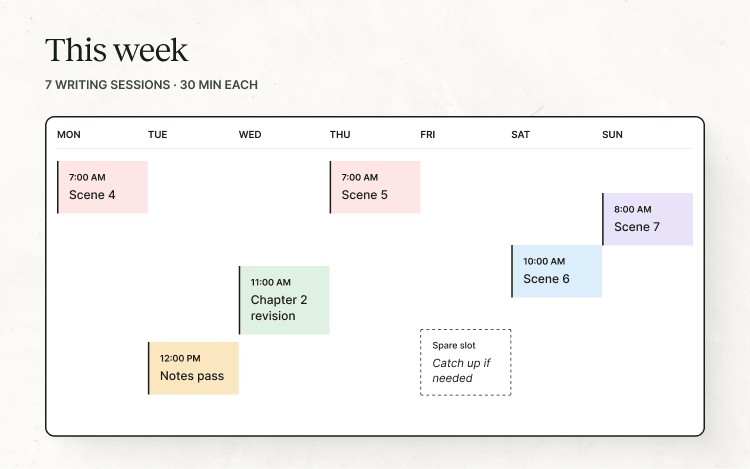
The difference matters more than it sounds. When a daily goal breaks, the whole plan feels broken. When a weekly session goal has one bad day in it, you still have five more chances to hit your number. A missed Tuesday just becomes a session to reschedule, not a reason to give up on the month.
Block time in your calendar like any other commitment
Once you know how many sessions you need, treat them the way you’d treat a meeting you can’t skip. Put them on the calendar at times you realistically control, rather than leaving them to whatever’s left over at the end of the day.
This is also where patience matters. Research on habit formation, most notably a widely cited study from University College London, has found that it can take as many as 80 days of consistent repetition for a new behavior to start feeling automatic. The same research found something reassuring for anyone who’s ever missed a session and spiraled about it: missing a single day didn’t meaningfully derail the habit-forming process, as long as you get back to the habit again as soon as you can. Consistency over time matters far more than any single session.
Use tools that support focus, not just willpower
Willpower is a limited resource, especially if you’re trying to write around a full-time job or a full house. Trust me, I know. Structure and small tools can make your writing sessions have more direction.
One tool that I love to use is called the Pomodoro Technique: working in short, focused bursts (often 25 minutes), followed by a brief break. The Pomodoro Technique helps me quiet the noise and pay attention to one specific task for a manageable amount of time.
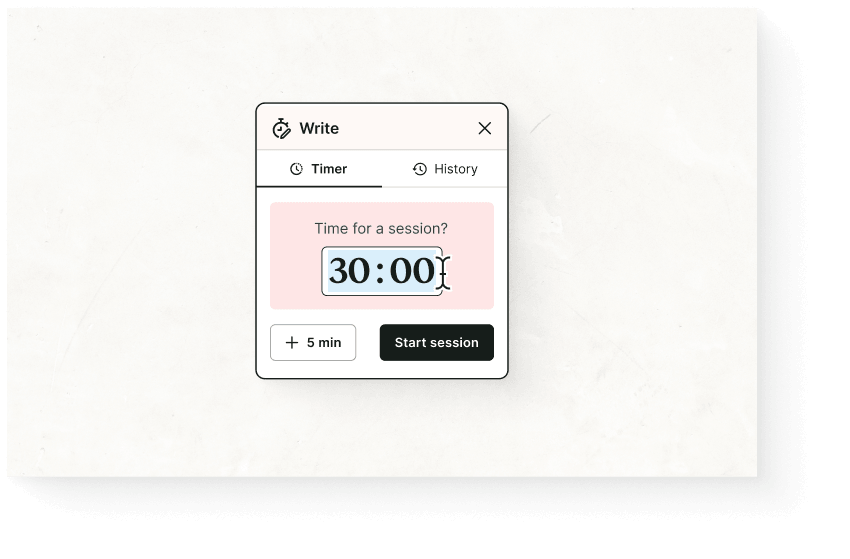
You don’t need a separate app to do this. ProWritingAid’s Write mode includes a built-in session timer, so you can set a focused writing block and work distraction-free without ever having to leave your document.
Find a community to write alongside
For a long time, I wrote alone, and I assumed that was just what writing was. I didn’t have a single friend who was working on a novel, so I had no one to compare notes with, no one to text when a scene finally clicked, and no one to remind me that the doubt I felt every time I sat down was completely normal.
That changed when I started making actual writing friends, people who were also deep in their own messy drafts. Suddenly I had somewhere to put the small wins that used to just evaporate and somewhere to admit the days I didn’t write at all without feeling like I was confessing a failure.
It’s a lot harder to believe you’re an impostor when you’re surrounded by people who take your writing seriously simply because you show up and do it, the same way they do. And it’s a lot harder to stop writing or fall out of your routine when you speak your goals aloud to people and have them ask you about them.
This is one of the reasons I point writers toward the ProWritingAid Community, where people share progress, swap accountability, and write alongside each other rather than in total isolation. A routine kept with other people is a lot more durable than one kept alone, and it turns out belief is easier to build in company too.
Track your progress, not just your plans
Drafting has always been the most exhausting part of writing for me. It’s the part where I can’t see the top of the climb yet, where the finish line is still theoretical, and where it’s easy to feel like I’m putting in effort without any proof it’s adding up to anything.
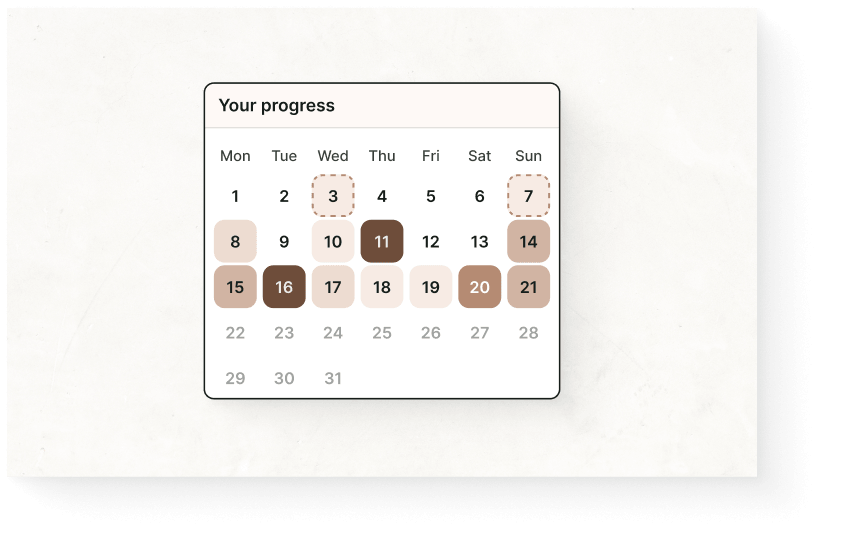
That’s exactly why tracking matters so much to me. A calendar tells you what you planned to do. Only tracking tells you what you actually did, and that record is what keeps a routine going long after the initial motivation wears off and long before you can see the end of the draft. That’s often the only evidence I have that I’m getting closer, and it’s usually enough to get me back to the desk tomorrow.
Some writers track word count, others track sessions completed or hours spent, regardless of output. What matters is picking something that gives you visible evidence of consistency, separate from how any single day’s writing felt. ProWritingAid’s habit trackers make this easy to keep visible, so the proof of your progress is sitting right where you’re already writing.
Putting your routine together
A writing routine that actually holds isn’t just a block of time on your calendar. It’s a goal that fits your real life, time you protect the way you’d protect any other commitment, tools that carry some of the weight so willpower doesn’t have to do it all, and people around you who make consistency easier than isolation ever could.
That combination, habit built alongside mindset and support, is the same thinking behind the ProWritingMethod. If you’re working on your own routine right now, ProWritingAid is free to start with, and it’s built with the support you need to create (and keep) your routine.

Finish your novel with ProWritingAid
Master the craft, habit, and mindset you need to reach "The End."